Protecting Outdoor Workers from Extreme Heat,
HeatSafe is here.
ISO / OSHA / KMA Standards · Risk assessment in 5 seconds · 100% Free
Calculate real-time heat index based on international guidelines (ISO, OSHA) and get essential rest time alerts and safety reports for your site.
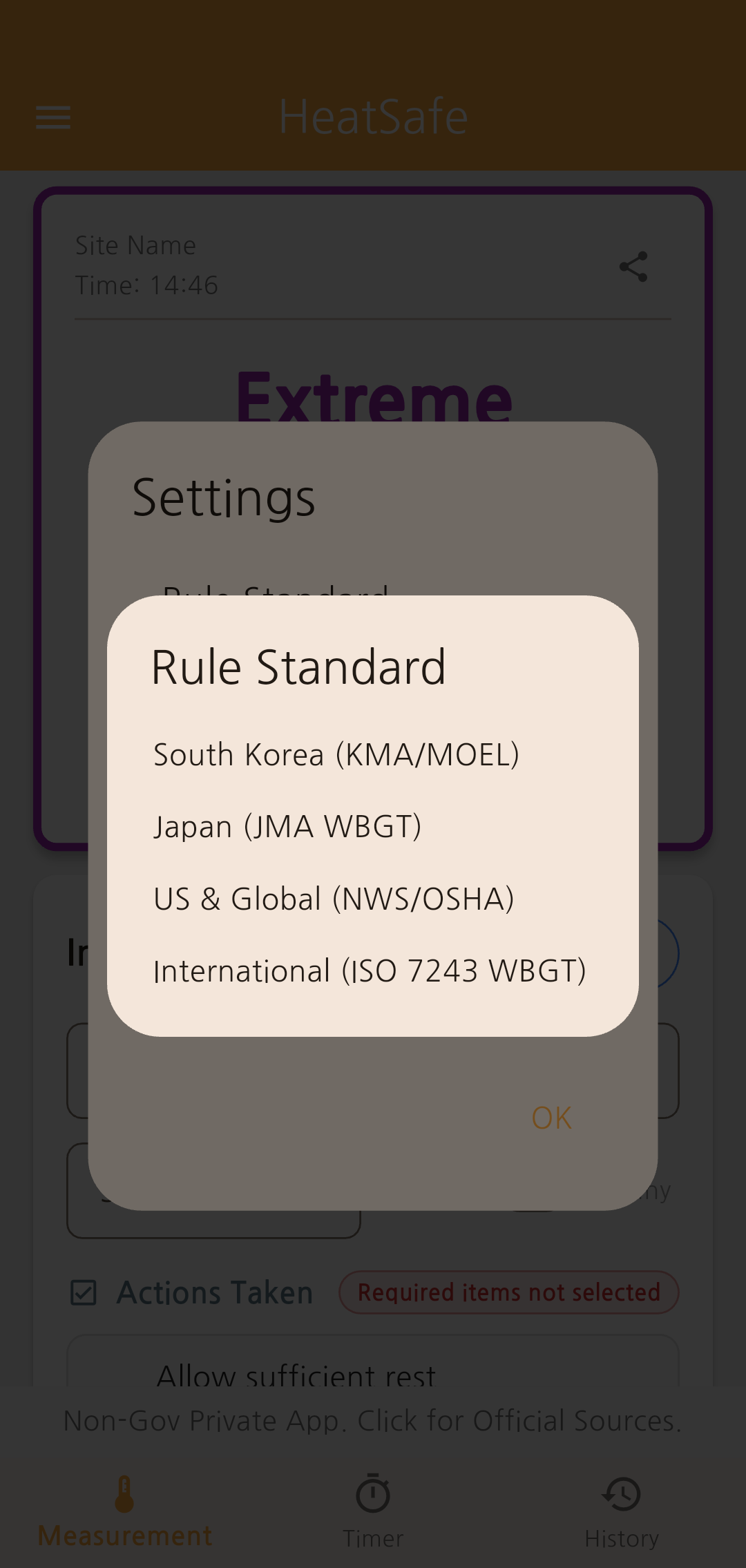
Key Features for Site Safety
Real-time Weather
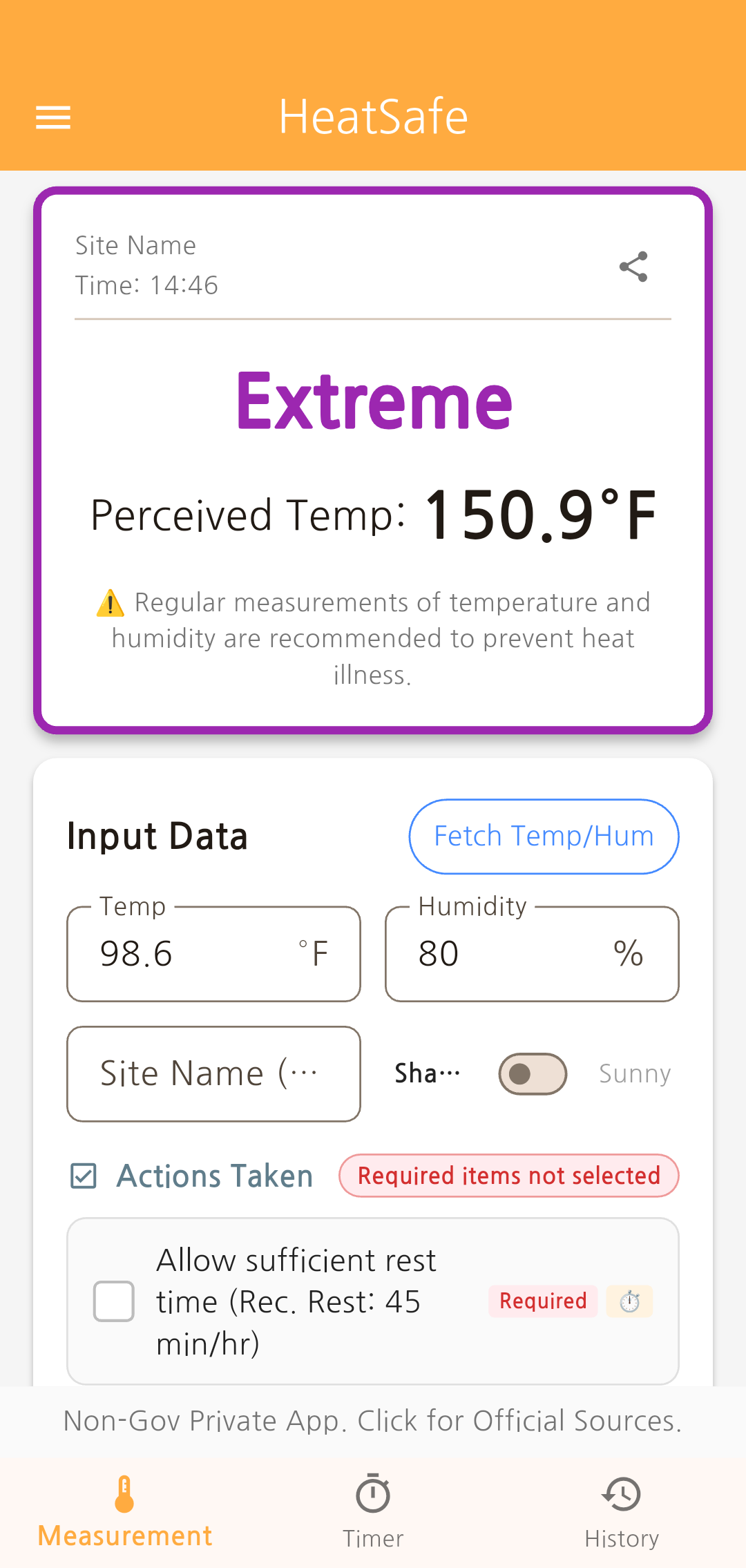
Automatically fetches temperature and humidity for your location to calculate heat index instantly.
Intuitive Risk Alerts
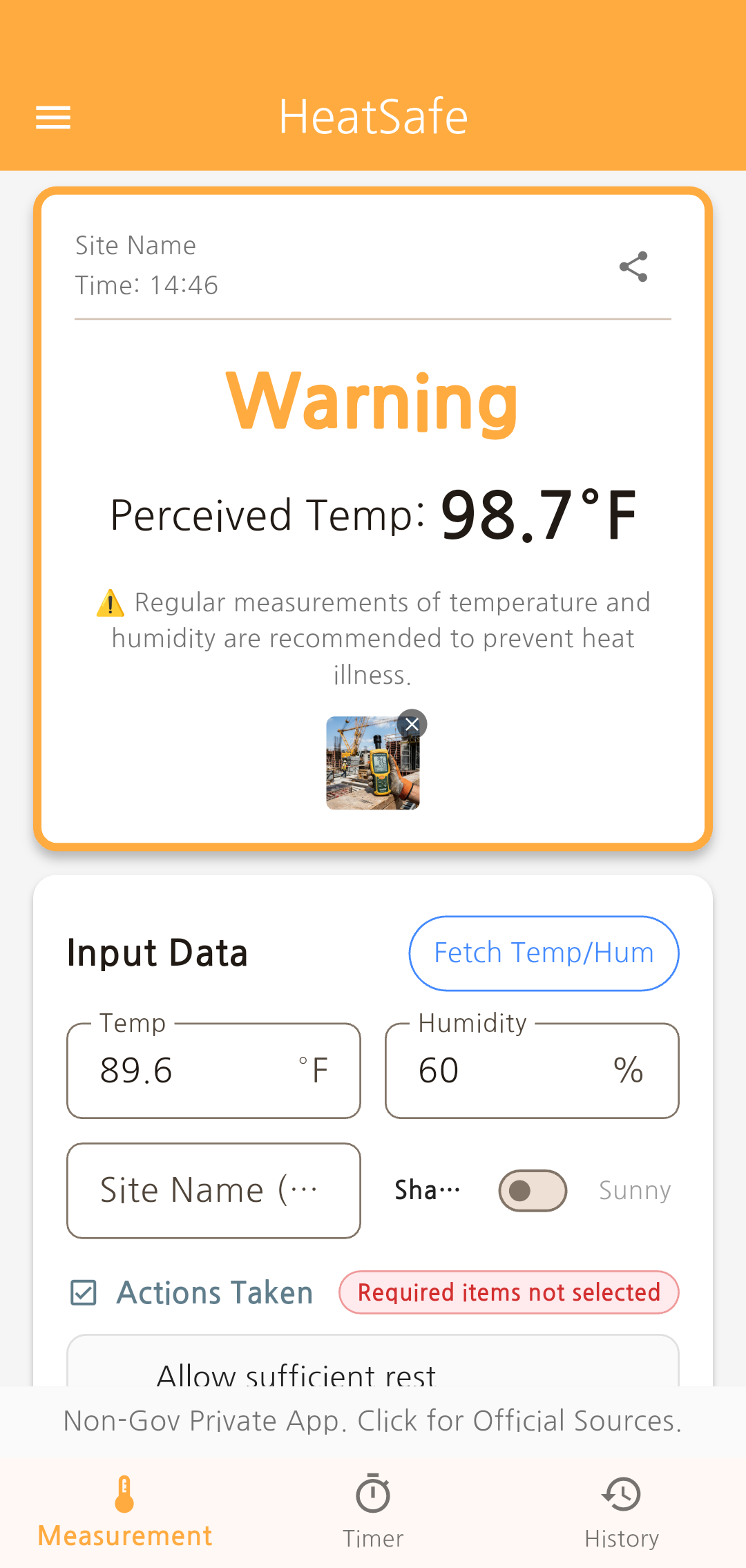
Track risk levels with 4 color-coded stages (Caution to Extreme) to understand safety at a glance.
Smart Rest Timer
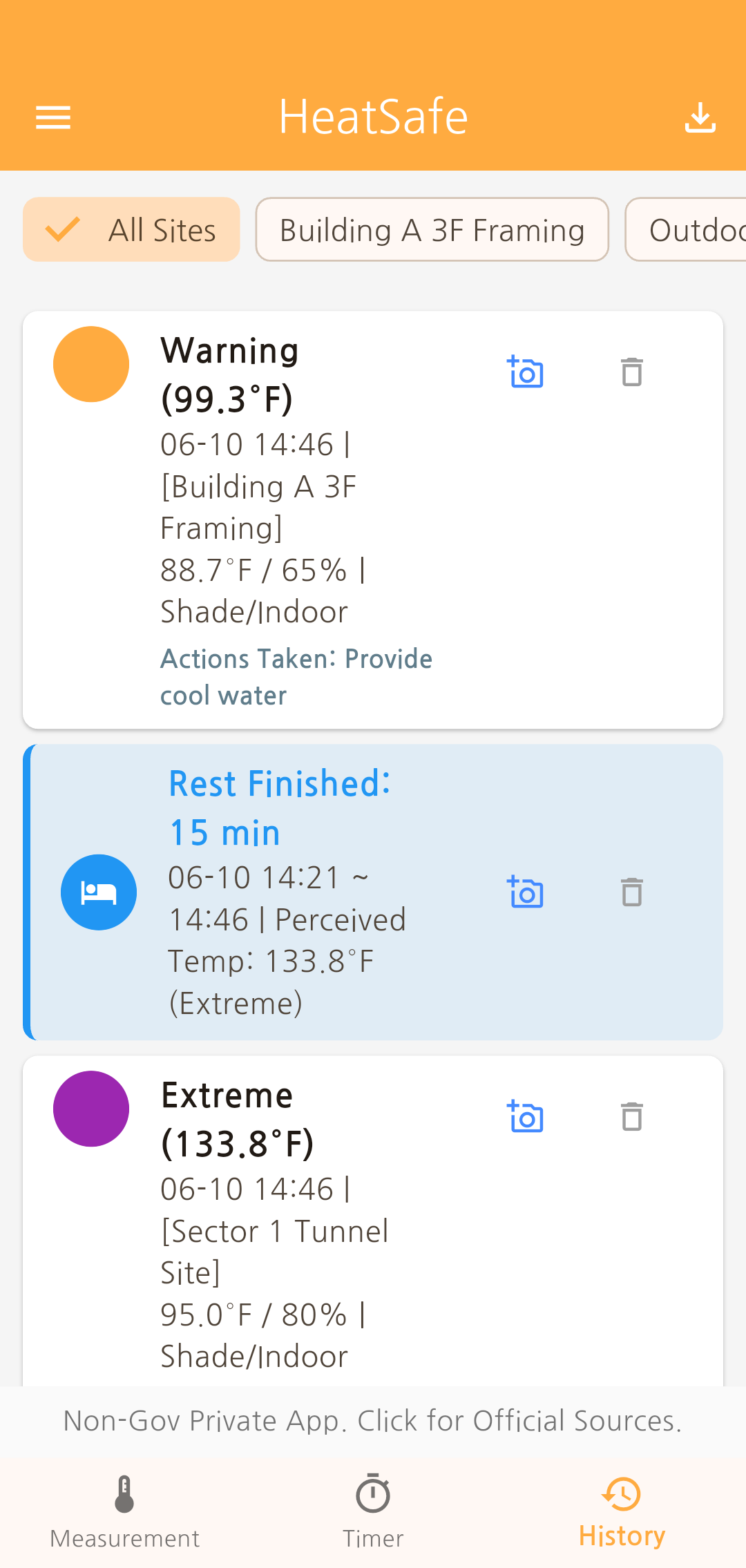
Automatically suggests rest intervals based on risk levels and alerts you when it's time to break.
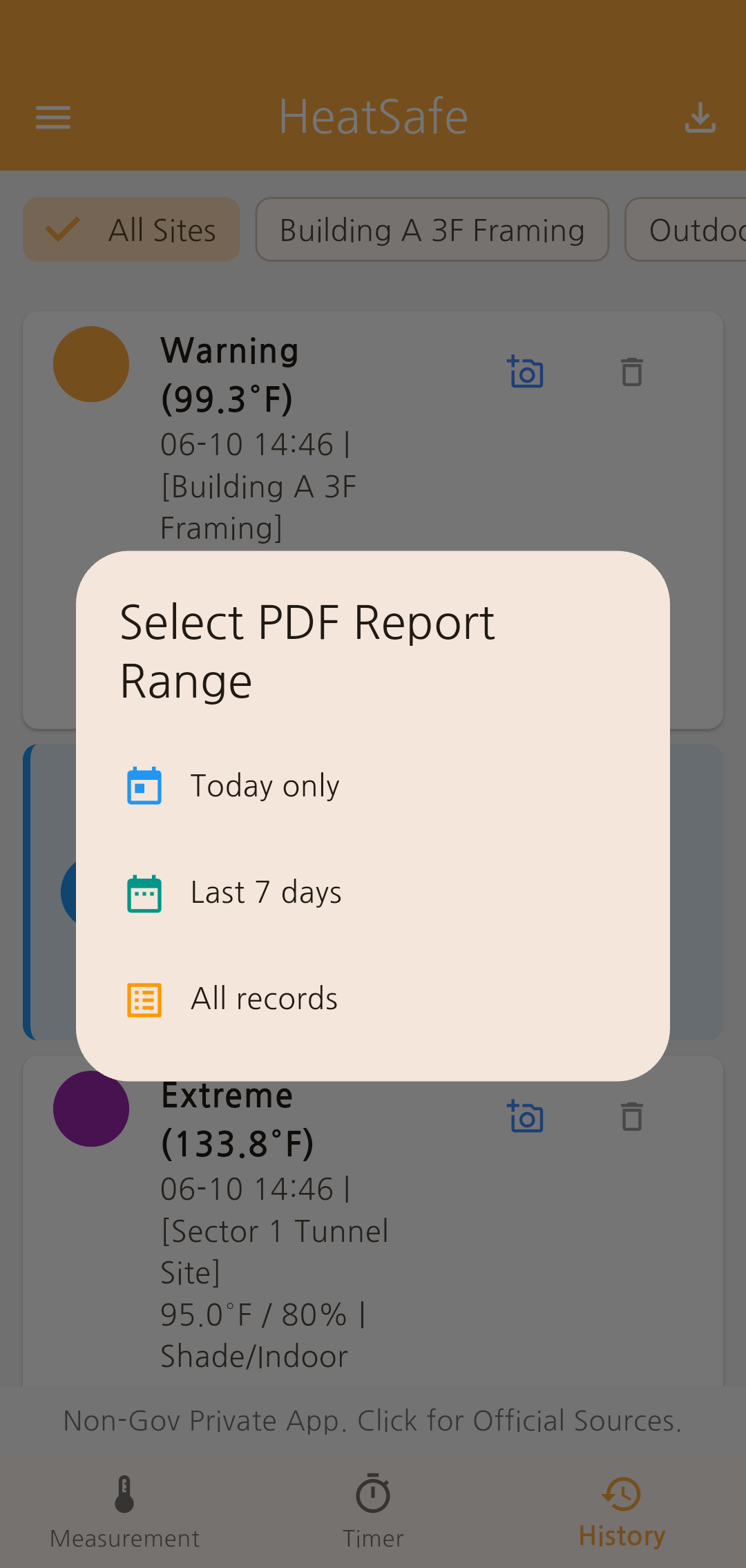
PDF Safety Reports
Generate professional reports with measurement history and evidence photos in one click.
Google Drive Backup
Safely sync your precious site inspection records and evidence photos to Google Drive automatically.
AI Smart Input
Simply point your camera at any thermometer and AI automatically reads the numbers in 1 second. No need to remove gloves.
3 Steps to Site Management
Measure & Record
Enter site temp/humidity and take evidence photos during site rounds.
Check Guidelines
Confirm recommended rest times based on calculated risk and start the timer.
Share Reports
Instantly report measurement logs via PDF at the end of the day via email or messenger.
Official Heat Safety Standards (NWS & OSHA)
HeatSafe calculations align with official guidelines set by the US National Weather Service (NWS) and the Occupational Safety and Health Administration (OSHA).
According to the National Weather Service (NWS), heat index risks are categorized into four levels based on apparent temperature (what it feels like when combining air temperature and relative humidity):
- Caution (80°F - 90°F): Fatigue is possible with prolonged exposure and/or physical activity.
- Extreme Caution (90°F - 103°F): Heat stroke, heat cramps, or heat exhaustion are possible with prolonged exposure and/or physical activity.
- Danger (103°F - 124°F): Heat cramps or heat exhaustion are likely; heat stroke is possible with prolonged exposure and/or physical activity.
- Extreme Danger (125°F or higher): Heat stroke is highly likely.
NWS Official Guideline: NWS Heat Index values are devised for shady locations. Exposure to full sunshine can increase heat index values by up to 15°F. HeatSafe includes a "Sunny / Shade" toggle to automatically apply this official correction factor for accurate field measurements.
OSHA's "Water. Rest. Shade." Campaign: Under the General Duty Clause, OSHA mandates that employers protect workers from extreme heat. The three core elements of prevention are:
- Water: Encourage workers to drink plenty of fluids (cool water) even if they do not feel thirsty (about 4 cups or 1 liter per hour during high heat).
- Rest: Implement recommended rest breaks to allow the body to cool down.
- Shade: Provide a fully shaded or air-conditioned rest area for recovery.
What is WBGT and Why Does It Matter?
WBGT (Wet Bulb Globe Temperature) is the internationally recognized index for measuring heat stress on the human body. It is used by OSHA, NIOSH, and ISO 7243 to set safe working conditions.
WBGT accounts for air temperature, humidity, wind speed, and solar radiation — four factors that determine how effectively the human body can cool itself through sweating. A plain air temperature of 95°F (35°C) may feel far more dangerous at 80% humidity than at 20% humidity. WBGT captures this real physiological heat burden.
Source: ISO 7243:2017 — Ergonomics of the thermal environment.
The US National Institute for Occupational Safety and Health (NIOSH) recommends the following work-rest ratios for outdoor workers under heat stress (Criteria Document for Occupational Exposure to Heat and Hot Environments, 2016):
- Light work (e.g., monitoring): 75% work / 25% rest per hour at WBGT ≥ 30°C (86°F).
- Moderate work (e.g., walking, carrying): 50% work / 50% rest per hour at WBGT ≥ 28°C (82°F).
- Heavy work (e.g., heavy lifting, digging): 25% work / 75% rest per hour at WBGT ≥ 27°C (81°F).
Source: NIOSH Publication No. 2016-106.
Under the General Duty Clause (Section 5(a)(1)) of the OSH Act, employers are required to provide a workplace free from recognized hazards, including extreme heat. OSHA's National Emphasis Program (NEP) on Outdoor and Indoor Heat-Related Hazards (Directive CPL 03-00-024, 2023) formally targets heat illness prevention across all industries.
Key employer obligations include: providing cool water near the work area, scheduling rest breaks in shade or air-conditioned environments, acclimatizing new workers, and training all workers on heat illness symptoms.
Source: OSHA.gov — Heat Illness Prevention Campaign.
Web Preview: Real-time Heat Index Calculator (OSHA/NWS)
A Proven Choice, Backed by Results
Achieved entirely through word of mouth from safety managers. Countless sites are experiencing the accuracy and convenience of HeatSafe.
Start Safety Today
Download now on Google Play Store.